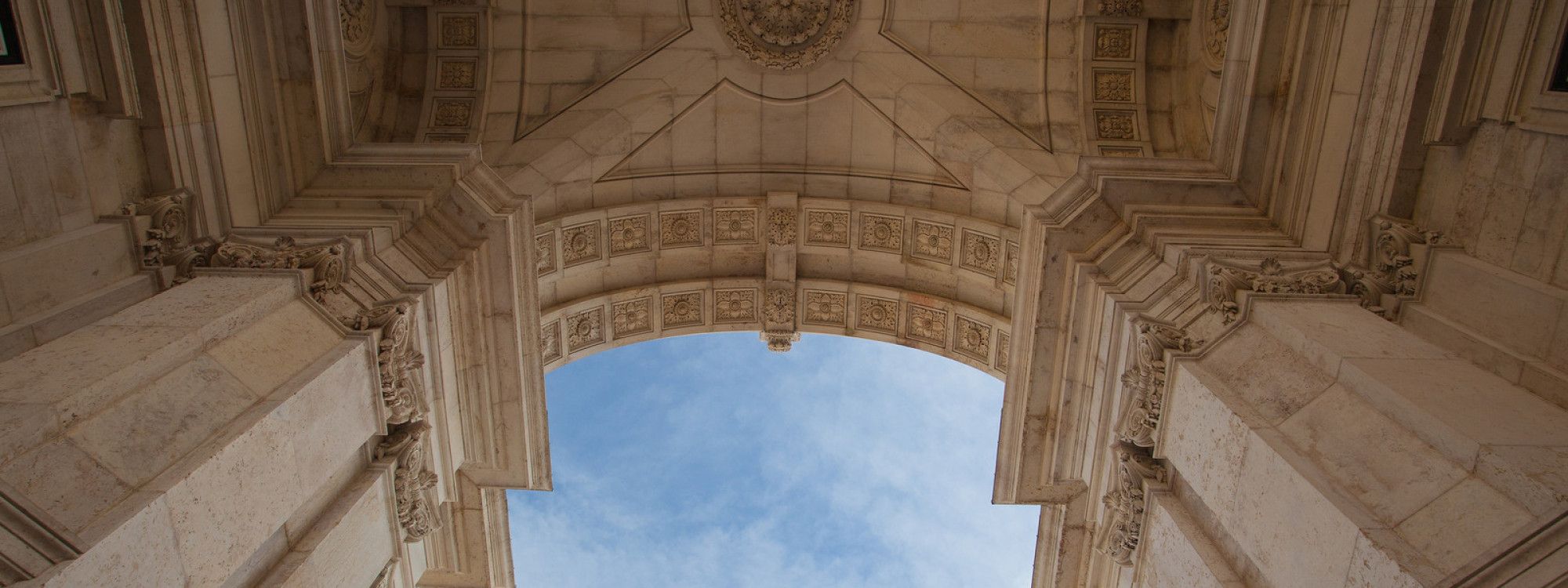
Rua Augusta Arch Lisbon: History & Views
The Rua Augusta Arch in Lisbon: its history after the 1755 earthquake, the statues and inscription, the rooftop viewpoint and tips for your visit.
November 8, 2022 • 5 min read
Rua Augusta Arch Lisbon: History & Views
Rua Augusta Arch at a Glance
The History of the Rua Augusta Arch
On November 1, 1755, an earthquake, followed by a tsunami and fires, destroyed much of Lisbon's center. The king's chief minister, later the Marquis of Pombal, had the Baixa rebuilt on a new grid of straight streets, and the royal palace on the river was replaced by Praça do Comércio, a great square open to the Tagus.

A monument was planned on the north side of the square from the start, where Rua Augusta meets it. The first idea was a bell tower, but the work dragged on for more than a century. In the 19th century, the architect Veríssimo José da Costa took up the project again as a triumphal arch. It was completed in 1873 and inaugurated in 1875.
What the Statues and Inscription Mean
The arch is a celebration of the rebuilding of the city and of Portugal's history. Look for these details on the side facing Praça do Comércio:
- The top group. By the French sculptor Célestin Anatole Calmels, it shows Glory rewarding Valor and Genius. Glory, about 7 meters tall, stands on a throne and holds two crowns.
- The four statues. Above the columns, by Vítor Bastos, stand four figures from Portuguese history: Viriathus, who fought the Romans, and the navigator Vasco da Gama on one side, and the medieval general Nuno Álvares Pereira and the Marquis of Pombal on the other.
- The two rivers. Two reclining figures represent the Tagus and the Douro, the great rivers of Portugal.
- The inscription. The Latin text reads VIRTVTIBVS MAIORVM VT SIT OMNIBVS DOCVMENTO PPD. It dedicates the arch to the virtues of the ancestors, as a lesson to all, and records that it was paid for with public money.
Walk around to the other side. The side facing Rua Augusta has a clock, and inside the arch, the clock room tells the story of the monument.

How to Visit the Rua Augusta Arch Viewpoint
The entrance is in the arch itself. A small lift goes up to the clock room, with an exhibition on the history of the arch, and from there about 74 steps lead to the terrace at the top.

From the top you can see:
- Praça do Comércio and the Tagus right below you
- Rua Augusta and the grid of the Baixa running north to Rossio
- São Jorge Castle and the Sé, Lisbon's cathedral
- The 25 de Abril Bridge to the west, on clear days
Tips for your visit:
- It is open every day. Opening hours vary between sources, so check the current times before you go.
- Go late in the afternoon. The light is softer, and the view toward the river at sunset is the highlight.
- Mind the stairs. The last part is a narrow climb, so it is not suitable for wheelchairs.
- Combine it. Praça do Comércio, the Sé and Alfama are all a few minutes away on foot.
Rua Augusta: Lisbon's Main Street
Rua Augusta runs through the Baixa from Rossio square to the arch, and it is closed to traffic. It is the heart of the grid built after the earthquake, lined with the uniform Pombaline buildings of the reconstruction, shops, cafés and restaurants, with street performers in the evening. In December, it is one of the streets lit up for Christmas.
A walk along Rua Augusta fits easily into a first day in Lisbon. From Rossio, walk south to the arch and Praça do Comércio, then continue to the Sé and Alfama, or west to Cais do Sodré along the river.
Where to Stay Near Rua Augusta
The Baixa and Chiado are the most central areas of Lisbon, ideal for a first visit, with the main sights, the metro and the river within walking distance.